[ad_1]
Gartner: Hypervisor Replatforming Is Reshaping Storage and Virtualization Decisions
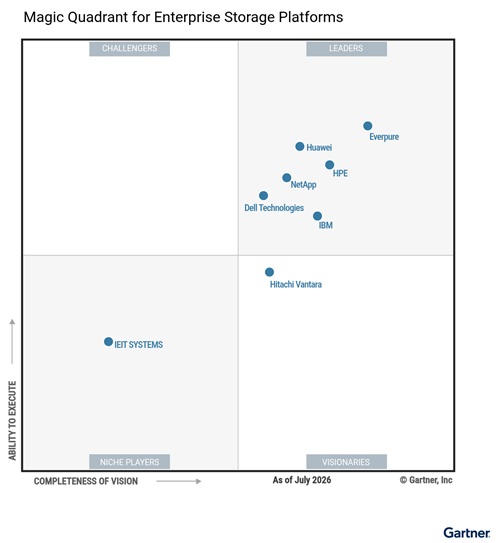
Gartner’s latest Magic Quadrant for Enterprise Storage Platforms points to a fundamental infrastructure shift: storage is becoming entangled with the upheaval taking place across enterprise virtualization.
The 2026 Magic Quadrant for Enterprise Storage Platforms says widespread licensing restructuring and pricing changes are prompting organizations to reconsider hypervisor strategies, creating what Gartner calls a “major displacement window.”
That transition is changing storage buying decisions along with virtualization decisions. Gartner says IT leaders increasingly need to evaluate virtualization and storage platforms as a combined entity, with buyers prioritizing multihypervisor flexibility, container interoperability, and automated VM-conversion tools that can reduce the friction of moving workloads.
Storage Joins the Hypervisor Replatforming Fight
Gartner specifically advises infrastructure and operations leaders to avoid storage platforms that tightly bind data to a single hypervisor. Instead, it recommends platforms that support hypervisor-agnostic deployment and VM-to-container migration across technologies including Red Hat OpenShift, Nutanix AHV, Microsoft Azure Local, and KubeVirt.
The guidance reflects a broader change in Gartner’s definition of the enterprise storage platform itself. Rather than treating storage primarily as discrete block, file, and object products, Gartner now emphasizes a centrally managed control plane that unifies those workloads across on-premises and hybrid IT environments.
In that model, storage increasingly becomes part of the infrastructure operating layer rather than simply capacity attached to it — particularly as organizations redistribute workloads among virtualization platforms, containers, edge environments, and public cloud services.
Cloud-Style Economics Move On-Premises
Another major theme is the shift away from traditional storage purchasing. Gartner predicts that by 2029, consumption-based storage as a service (STaaS) will replace 50% of on-premises enterprise storage and data-services infrastructure capex, up from 25% in early 2026.
Gartner recommends moving sourcing toward consumption-based, service-level-agreement-backed STaaS models as a way to reduce exposure to hardware price inflation and technology obsolescence. In effect, more enterprise storage is being purchased and operated using the same pay-for-use and service-level principles associated with public cloud infrastructure, even when the hardware remains inside the data center.
That transition could be accelerated by what Gartner describes as an unusually severe storage cost environment. The firm says infrastructure leaders should budget for 250% to 300% of their 2025 storage spending in 2027 to accommodate rising memory and storage prices.
[ad_2]
Source link
Leave a Reply