[ad_1]
Report: Cloud Crime on the Rise as Attackers Exploit Trust
Cyber attackers are increasingly turning the technologies and relationships organizations trust most — including cloud identities, AI tools, software dependencies and legitimate authentication processes — into paths for intrusion, according to CrowdStrike’s latest threat-hunting research.
The CrowdStrike 2026 Threat Hunting Report, based on activity observed from July 1, 2025, through June 30, 2026, documents a 171% increase in cloud-conscious eCrime activity as financially motivated adversaries pursued credentials, cryptomining capacity, large language model access, and digital financial assets.
The cloud finding is part of a broader shift running through the 59-page report. Rather than simply breaking through an external perimeter and moving laterally across endpoints, adversaries are increasingly entering through trusted accounts, tokens, applications and software components. Once authenticated, they can operate inside cloud and software-as-a-service (SaaS) environments using mechanisms that resemble legitimate business activity.
To demonstrate the difference in focus since last year, here is the company’s 2026 highlight infographic:

Here is the company’s 2025 highlight infographic:
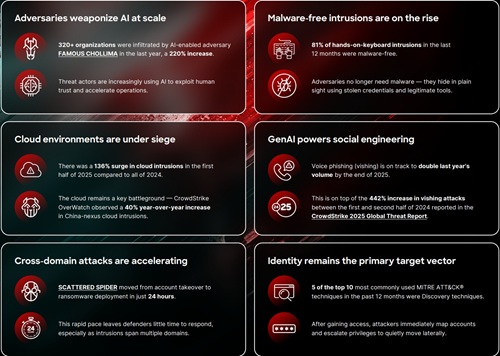
AI Becomes Tool, Target and Attack Surface
Artificial intelligence appears throughout the report in several distinct roles. Adversaries used generative AI to produce commands, payloads, reconnaissance scripts, and credential-harvesting tools. Other attackers targeted AI infrastructure itself to steal access, consume computing resources, or obtain sensitive configuration information.
CrowdStrike OverWatch found that AI agent-triggered detection leads were appearing at 2.5 times the rate of human-triggered leads. The finding does not compare the accuracy or effectiveness of AI agents with human hunters. Instead, CrowdStrike presents it as evidence that AI-generated activity is increasing the volume and speed of signals that defenders must investigate.
One financially motivated attacker used a compromised cloud identity and long-term access key to target a cloud service providing access to foundation models. After testing account permissions and creating temporary credentials, the attacker flooded the service with nearly 200,000 application programming interface requests in two minutes.
CrowdStrike characterizes such activity as “LLMJacking,” in which an adversary obtains unauthorized access to an organization’s large language model resources. The resulting harm can include service charges, exhausted quotas, and operational disruption even if the attacker does not steal conventional enterprise data.
[ad_2]
Source link
Leave a Reply